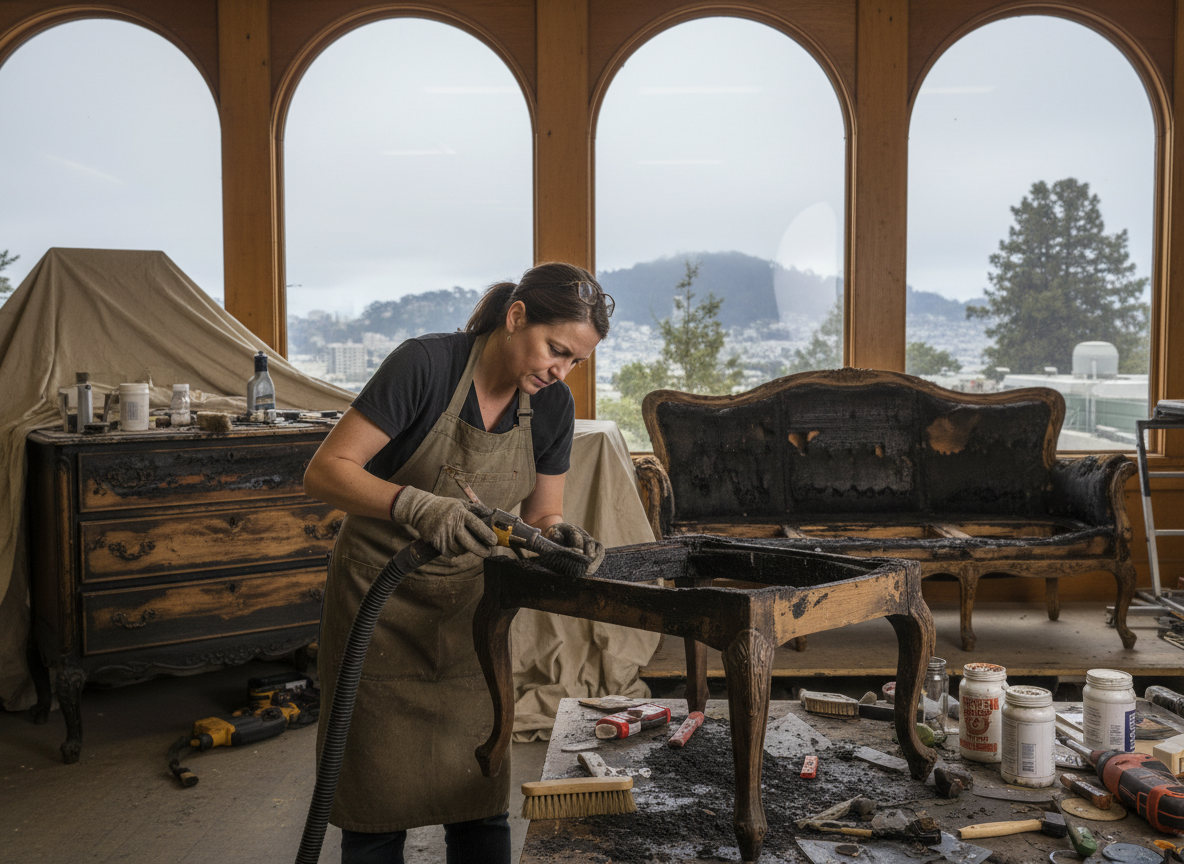
Twin Peaks sits at elevation in San Bernardino County where homes often feature older pine and oak furniture that absorbs smoke deeply during structure fires. Warm summers dry out finishes quickly while cold snowy winters drive moisture into any remaining soot residue, causing warping and hidden delamination in tabletops and cabinetry. Restoration starts with pH-neutral cleaning agents matched to the wood species, followed by targeted odor neutralization using hydroxyl generators rather than ozone that can degrade finishes on antique pieces common in Lake Arrowhead and Crestline cabins.
Edge cases arise with particleboard and veneer items popular in 1970s mountain builds; these swell unevenly after water used to suppress fires, requiring disassembly before any refinishing. We document every joint and hardware condition before work begins because insurance carriers in the area scrutinize claims for pre-existing wear from seasonal humidity swings. Proper drying at controlled temperatures prevents mold that thrives once snowmelt raises indoor moisture levels in the weeks after an incident.
Regulation notes include following San Bernardino County air quality rules when disposing of contaminated fabrics and foams, which must be sealed on-site before transport. Homeowners sometimes attempt DIY vinegar cleaning that sets smoke stains permanently into grain; professional teams use sequential solvent testing to avoid that outcome on cherry and maple pieces found throughout Twin Peaks neighborhoods.
Final sealing employs low-VOC lacquers rated for high-altitude UV exposure so restored pieces do not yellow after placement near south-facing windows common in local homes.
Technician insight
In Twin Peaks, the thing that catches most people out with fire-damaged furniture restoration is how the cold snowy winters make wood contract after smoke exposure, opening micro-cracks that only show once spring humidity returns if the piece was not sealed with products formulated for our elevation and temperature swings.
Crestline Cabin Sideboard
Smoke from a kitchen fire migrated into a 1980s oak sideboard in a Twin Peaks home. We found heavy soot inside all drawers and water rings on the top from suppression efforts. After disassembly, solvent cleaning, and reassembly with new drawer slides rated for cold-weather movement, the piece returned to service without odor or visible damage.
How it works
- 1
Initial Assessment
Inspect each piece on-site for smoke penetration depth, water damage, and structural integrity using moisture meters and UV lights suited to Twin Peaks elevation.
- 2
Contaminant Removal
Apply specialized cleaners and odor neutralizers in a contained workspace to extract soot without spreading residue into the home's HVAC system.
- 3
Repair And Refinishing
Stabilize joints, replace damaged veneer sections, and apply protective coatings matched to the original wood and local climate demands.
- 4
Final Placement And Monitoring
Return items after 48-hour off-gassing and check for any seasonal movement once returned to the home's winter heating cycle.
Pricing
Cost depends on number of pieces, material type, and extent of smoke versus water damage; we provide written scope before any work.