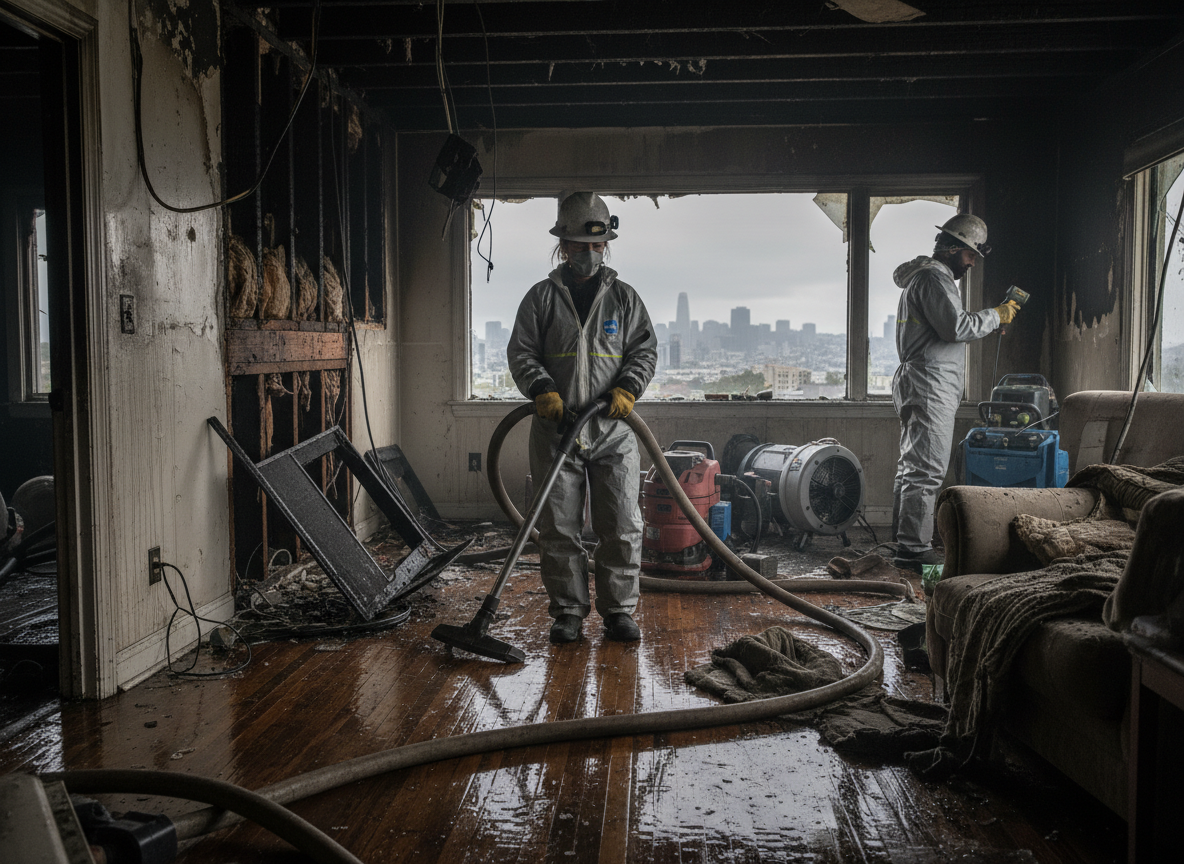
Twin Peaks sits at elevation in San Bernardino County where summer brush fires often leave scorched slopes that later funnel snow-melt and rain directly into crawl spaces and foundations. Older cabin-style homes built from the 1950s through 1970s commonly feature pier-and-beam construction with limited access, so water from post-fire runoff travels under floors and saturates subfloor plywood before homeowners notice. Restoration crews must first stabilize any remaining structural char, then extract hidden moisture while the ground is still frozen or saturated.
After a fire, the county requires permits for any structural repairs and inspections once drywall is removed. In Twin Peaks the steep driveways and narrow roads around Highway 189 slow equipment delivery, so teams stage drying equipment on site for longer periods than in flatland cities. Flooding after fire also carries ash and sediment that clogs French drains and sump pumps common in Crestline and Lake Arrowhead properties, requiring full line cleaning before dehumidification can finish.
Edge cases include overlapping insurance claims when a winter storm follows a summer fire; adjusters need clear photo documentation of char lines versus water lines on the same framing members. Crews also watch for mold growth in wall cavities once heat from drying equipment raises indoor humidity in tightly sealed mountain homes.
Technician insight
In Twin Peaks the thing that catches most people out with Fire and flood restoration is how quickly snow-melt finds the old crawl-space vents after a fire strips the slope above the house. You think the water is gone until you pull up the subfloor and find ash-laden mud packed against the rim joists from the winter before.
Post-Fire Snow-Melt Intrusion on Highway 189
A cabin off CA-189 lost its roof to a summer fire then took on several inches of water when January snow melted and ran down the scorched hillside. We found saturated insulation and mold already forming under the living-room floor. Extraction and targeted drying prevented full subfloor replacement; the owners moved back in before the next storm cycle.
How it works
- 1
Emergency Board-Up and Site Stabilization
Secure the structure against weather and unauthorized entry while documenting all visible fire and water damage for insurance.
- 2
Moisture Mapping and Contamination Assessment
Use meters and infrared cameras to locate hidden water behind walls and under floors, noting ash and sediment carried in by snow-melt runoff.
- 3
Water Extraction and Structural Drying
Remove standing water and place commercial drying equipment suited to cold mountain temperatures and limited power access.
- 4
Sanitizing and Odor Removal
Treat affected materials for smoke residue and microbial growth, then ventilate to mountain air standards.
- 5
Rebuild and Final Inspection
Replace damaged framing and finishes, coordinate with San Bernardino County inspectors, and verify moisture levels before turnover.
Pricing
Upfront quotes after on-site inspection; cost driven by access on steep Twin Peaks lots, volume of hidden water in older pier-and-beam homes, and length of drying time required during snowy months.