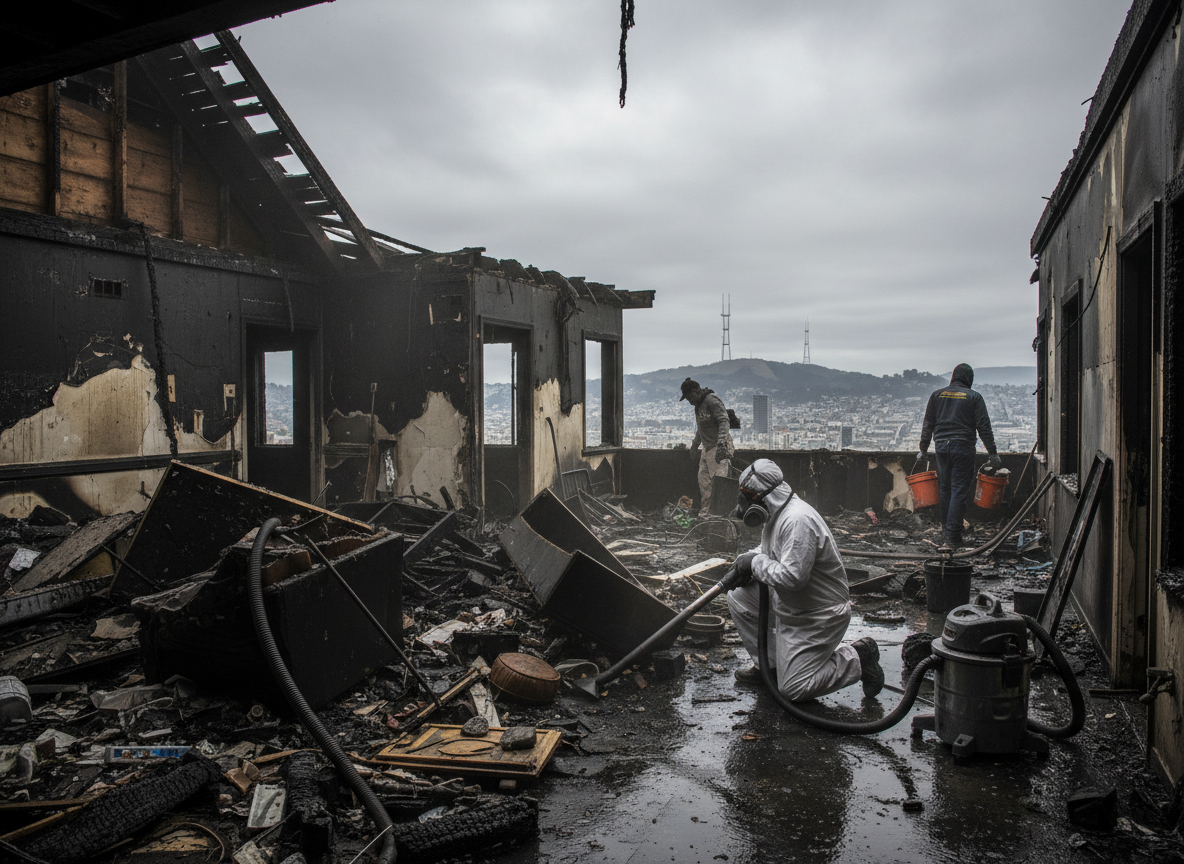
Apartment fire cleanup in Twin Peaks often involves older wood-frame buildings common throughout San Bernardino County near Lake Arrowhead and Crestline. Smoke penetrates drywall, insulation and HVAC systems quickly in these compact units, leaving acidic residues that corrode metal fixtures and wiring if not neutralized within days. Cold snowy winters exacerbate the problem by condensing moisture inside wall cavities, turning dry soot into corrosive sludge that migrates to lower floors.
Technicians must account for the steep terrain around Twin Peaks when staging equipment and containing airborne particles. Wind patterns along Highway 189 can carry soot into neighboring units, requiring negative-air machines and sealed barriers between apartments. Summer heat accelerates off-gassing of burned plastics, while winter freezes complicate water extraction from shared plumbing lines that run through unheated crawl spaces typical of local mountain construction.
Edge cases include hidden charring in balloon-framed walls and odor trapped in shared attics. Crews test pH levels on every surface because alkaline cleaners used in coastal areas fail against the acidic smoke common from wood-burning stoves prevalent in Twin Peaks apartments. Final clearance requires moisture meters and air sampling to confirm no residual humidity remains before drywall replacement, preventing mold growth during the next snow season.
Technician insight
In Twin Peaks, the thing that catches most people out with Apartment fire cleanup is how quickly snowmelt seeps into soot-damaged insulation along shared walls during the first thaw after a winter fire near Lake Arrowhead.
Crestline Road Apartment Unit
A kitchen fire spread smoke through an older apartment near Crestline Road. We found acidic soot had migrated into the HVAC and condensed inside exterior walls during a cold snap. Containment and pH neutralization prevented further corrosion, and targeted drying kept moisture from reaching the unit below before reconstruction.
How it works
- 1
Initial Assessment
Inspect all affected units, test surfaces for soot depth and pH, and document hidden moisture pockets created by winter condensation in Twin Peaks apartments.
- 2
Containment And Air Scrubbing
Set up negative pressure zones and HEPA scrubbers to prevent cross-contamination between units along the steep Highway 189 corridor.
- 3
Soot Removal And Neutralization
Apply pH-adjusted cleaners to walls, ceilings and HVAC components, followed by thermal fogging to reach crevices common in older mountain construction.
- 4
Drying And Odor Verification
Use commercial dehumidifiers and air movers during cold months, then confirm no residual smoke odor before reconstruction begins.
Pricing
Cost depends on square footage affected, number of units involved, and whether winter moisture has spread into shared walls.